Junior Information
  • Home
  • HS Courses and Credits
  • Timeline
  • Making High School Count
  • College Information
  • Self Care

College Information/Applications.
Picture
Counselors meet with juniors in small groups each year in the spring to go over the college application process and things they need to be thinking of during the summer going into their senior year. Please click on the links below to access information from that meeting (include the Student Profile Form and Parent Response Form that we ask are filled out.
Junior Information PowerPoint
Student Profile Form
College Application Tip Sheet
Parent Response Form
Picture
TAKE A TOUR
Tips for a successful CAMPUS VISIT
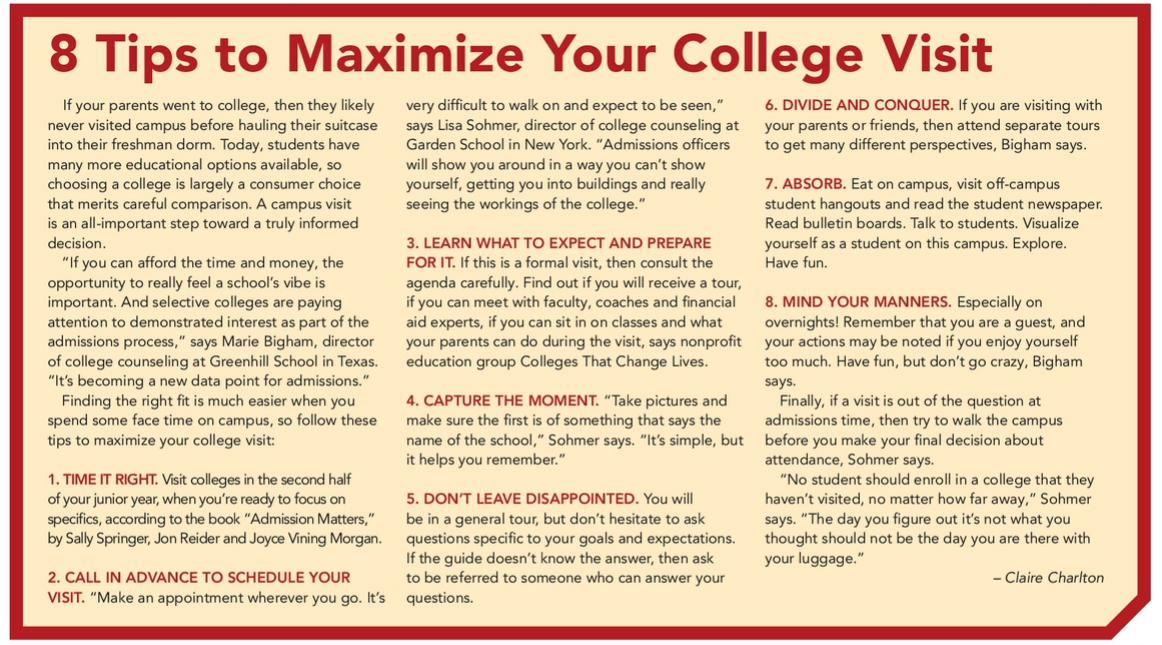
  1. Take a tour
  2. Meet w/an admissions officer
  3. Attend a class
  4. Ask questions about admissions, cost, & social activities
  5. Talk to students on campus
  1. Check out the dorms, dining hall, & library
  2. Eat in the dining hall
  3. See the community
  4. Write a thank-you note to the admissions office after your visit
Picture
Student Athletes
 
If you plan on competing in Division I or Division II college sports and want to be eligible to be recruited by colleges, you must register with the NCAA Initial Eligibility Clearinghouse. www.eligibilitycenter.org

Important!
Neither the Rochester Community Schools nor its staff are affiliated with the NCAA and cannot be responsible for interpreting NCAA requirements.* It remains the sole responsibility of the student at all times to make sure that he/she is satisfying the necessary NCAA requirements for Division I or Division II. Please contact the NCAA directly with any questions concerning the NCAA eligibility requirements.

​*Rochester Community Schools’ graduation requirements are not the same as NCAA requirements.  
College Applications at-a-Glance
Completing college applications can be a time-consuming process. However, if you are organized and get started early, the process will feel much less stressful. Here is an overview of some things you should be doing as a junior to prepare for applying to college:

  • Make a list of schools (approx. 3-6) that you want to apply to and make a plan to visit them in person (*see the "8 tips" below for more information).
  • Create (or add to) your college résumé so you have all of the information colleges ask for in one place. Things to include on your college résumé are as follows:
    • Extracurricular Activities (dates involved, leadership roles, and a short description as well)
    • Community Service / Volunteer Activities (dates and descriptions)
    • Awards and Achievements (dates and descriptions)
    • Hobbies / Special skills (examples – fluent in another language, play an instrument, etc.)
    • Be sure that the things you list on your college résumé  are from high school years only!
  • Take some time to clean up your social media sites in case college reps. decide to look you up. 
  • You can begin working on your apps the summer before your senior year. Most applications open up on August 1st. You are able to submit your portion of the application prior to the start of school. Keep in mind, however, that schools will not review your application until ALL of the components are submitted. This includes transcripts, test scores, school reports, and any letters of recommendation.
NOTE: Transcripts, recommendation letters, and school reports will not be submitted until fall.

Application Steps
  • Go directly to the college’s website and click on Undergraduate Admissions.
  • Create an account with each college (keep all your usernames and passwords in one place).
  • Begin the application (most schools have a “save for later” option so you do not have to complete everything in one sitting).
  • If a school requires essays (and some require multiple), write them over the summer and revise them later.
  • If a school requires a letter of recommendation, it can be helpful to ask teachers or counselors before you leave for the summer. This allows ample time for completion. These letters are not submitted until fall.
 
Three Types of Admissions
There are generally 3 different types of admissions: Rolling Admission, Early Action, and Early Decision.
  1. Rolling Admission: There is no set deadline but still plan on submitting by Nov 1st
  2. Early Action: There is a set deadline, usually November 1st
  3. Early Decision: There is a set deadline, and this decision is binding
*Pay attention to each school’s application deadlines
 
*Counselors will hold a group senior meeting with you one week into your senior year to review the application steps and give information about requesting a transcript. Individual meetings will follow.
NOT ATTENDING a 4-YEAR COLLEGE?
Here are some other options…
Community Colleges
  • Community colleges offer two-year Associate Degrees, technical classes, flexible class schedules, some on-line courses, and affordable tuition.
  • Core credits can typically be transferred to a four-year university though most colleges and universities require a minimum of a 2.0 for credits to transfer.
  • Examples of degrees that require a two-year degree: dental hygienist, radiation therapist, ultrasound technician, registered nurse, and engineering technician.
Certificate Programs
  • Some careers require people to get certificates to prove that they have trained for a job at an approved school and that they have completed a certain number of hours practicing new skills.
  • Some jobs that require a certificate include: massage therapist, kennel management, medical assistant, computer technology, office assistant, and career development facilitator.
Military Careers
  • The military offers career options and tuition assistance. The level of commitment and benefits vary greatly; for more information visit www.todaysmilitary.com and make an appointment to speak with a recruiter.
Apprenticeships
  • An apprenticeship is a combination of on-the-job training and related classroom instruction through which workers learn the practical and theoretical aspects of a highly-skilled occupation.
  • Apprenticeship programs can be sponsored by individual employers, joint employer and labor groups, and/or employer associations. Most apprentice programs require four years to complete.
On the Job Training
  • Examples of careers that may offer on-the-job training include waiters and waitresses, fast food cooks, store clerks, hotel housekeepers, and lawn care workers.
Vocational and Trade Schools
These schools train students for a variety of skilled jobs such as automotive technician, emergency medical technician (EMT), hair stylist, paralegal, and truck driver. You can visit www.trade-schools.net for more information or search trade schools through Xello at: https://auth.xello.world/Google/Student/55277b54-e241-4e2a-b631-c83dcfe92b9b
​
Career Planning Resources
 
School & Career Planning www.mappingyourfuture.org
Scholarship Search www.fastweb.com
Bureau of Labor Statistics www.stats.bls.gov
Occupational Outlook handbook www.bls.gov/oco
Mapping Your Future https://mappingyourfuture.org/
Princeton Review www.princetonreview.com
College Board www.collegeboard.org
​​
Powered by Create your own unique website with customizable templates.
  • Home
  • HS Courses and Credits
  • Timeline
  • Making High School Count
  • College Information
  • Self Care
